In the rapidly evolving landscape of AI-assisted development, we are witnessing a tectonic shift from "Autofill" to "Autopilot." While early tools focused on predicting the next line of code, the new generation of AI Coding Agents is designed to manage entire project lifecycles.
Among these, OpenCode has emerged as a formidable open-source contender, offering a flexible, model-agnostic alternative to proprietary systems like Claude Code or GitHub Copilot.
The "Agentic" Workflow: How It Works
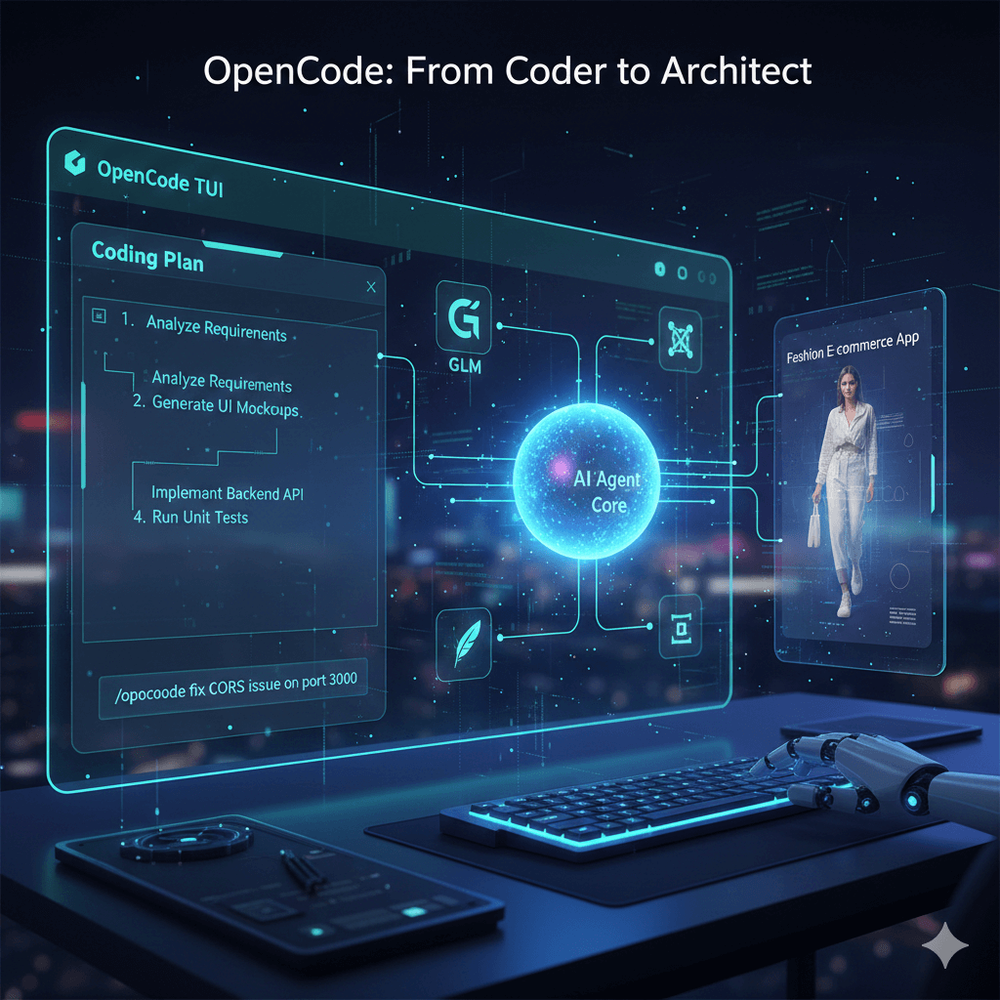
A truly effective AI development process isn't just about writing code; it’s about structured planning. A modern "3.0" workflow typically involves four distinct phases that OpenCode handles through its TUI (Terminal User Interface) and orchestrated agents.
1. The Interactive PRD Phase
Instead of guessing intent, the agent acts as a Product Manager. It utilizes a specialized "system rule" (often defined in an agents.md file) to challenge the developer's initial prompt. It asks critical questions regarding user authentication, data persistence, and UI requirements before a single line of code is written. This ensures the Product Requirements Document (PRD) is robust and aligned with the final goal.
2. UI-First Development with Multimodal AI
One major pitfall of AI-generated apps is "functional but ugly" interfaces. A sophisticated workflow solves this by using a two-step visual process:
- Prompt Engineering for UI: The agent generates specific design prompts based on the PRD.
- Prototyping: These prompts are fed into high-end vision models (like Imagen 3 or Flux) to create high-fidelity mockups. The AI developer then uses these images as a visual reference to ensure the generated CSS and layout match the intended aesthetic.
3. Decoupling and Security
A common mistake in AI-led development is hardcoding sensitive data. Advanced agents like OpenCode can automatically identify when an API key is exposed in the frontend and suggest a Backend Refactor. It can transition a pure client-side application into a secure Architecture (e.g., using Node.js or Express) where the AI logic is hidden behind a secure server-side proxy.
4. The "Document-Code" Synchronization Loop
The most powerful feature of an agentic workflow is its ability to keep documentation and code in a continuous loop. Whenever a new feature is added:
- The Plan Agent updates the PRD and Change Log.
- The Build Agent implements the code.
- The Test Agent verifies the deployment. This ensures that the project remains maintainable even as it scales, preventing the "AI debt" that occurs when code evolves faster than its documentation.
Why OpenCode is a Strategic Choice
Model Agnosticism
Proprietary tools often lock you into a single ecosystem. OpenCode’s greatest strength is its freedom of choice. You can leverage GLM-4 for its logical reasoning, Claude 3.5 Sonnet for its coding nuance, or Gemini 1.5 Pro for its massive context window—all within the same session.
Terminal-Centric Efficiency
For power users, the TUI provides a distraction-free environment. By integrating directly with the terminal, the agent can run tests, check port availability (and automatically resolve conflicts), and manage git commits without the user ever leaving the command line.
The Future: From Coder to Architect
The rise of tools like OpenCode signals a change in the developer's role. We are moving away from being "syntacticians" and toward being "System Architects." In this new era, your value isn't measured by how fast you can type a function, but by how effectively you can:
- Decompose complex problems into agent-readable tasks.
- Audit AI-generated logic for security and scalability.
- Orchestrate multiple AI models to perform specialized roles.
OpenCode isn't just a replacement for your editor; it’s a preview of the future of software engineering—collaborative, autonomous, and incredibly fast.